Interview with a pathologist: what happens during a post-mortem examination
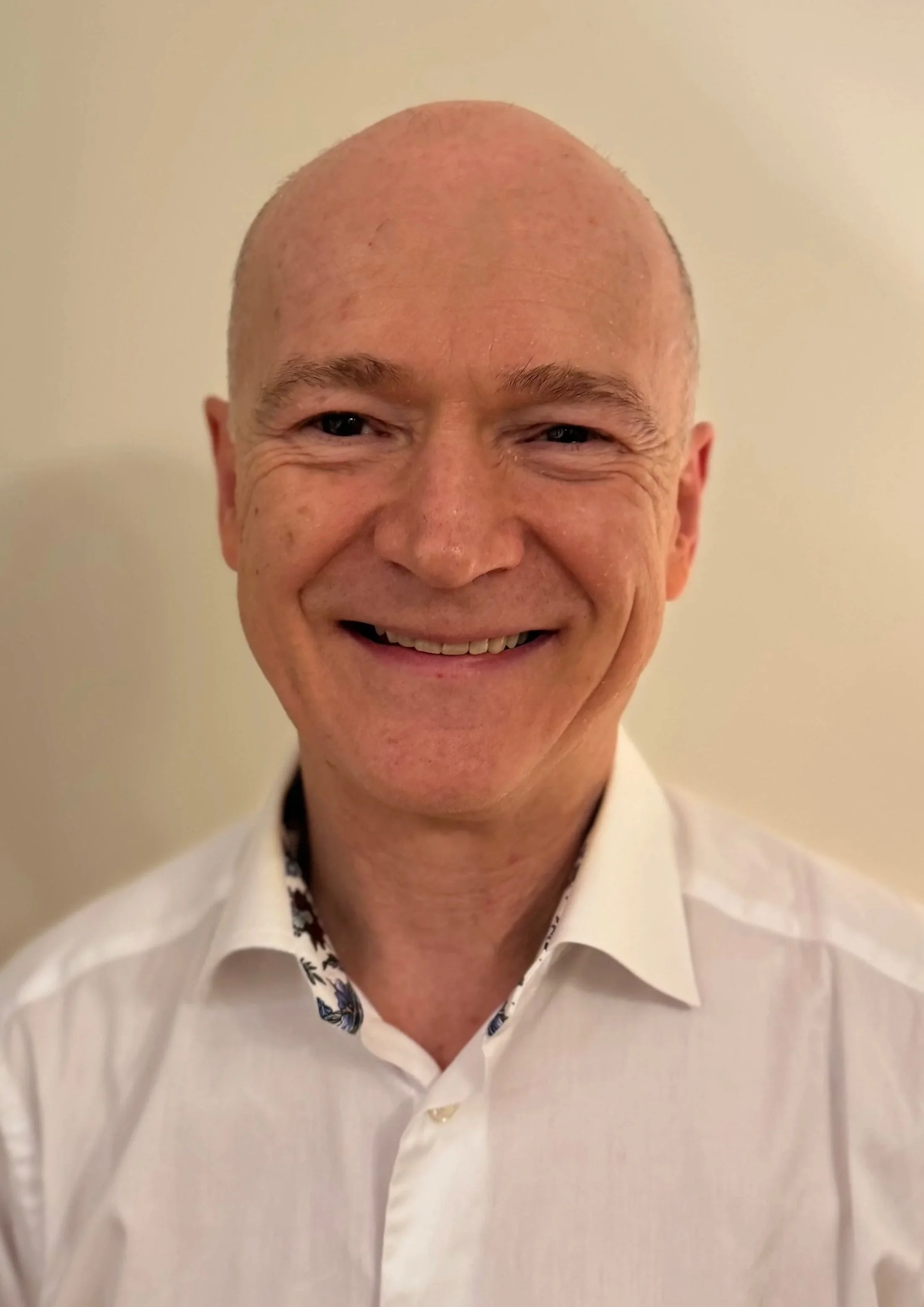
We were delighted to have the opportunity to speak to Chris Meehan, Consultant Histopathologist at the Royal United Hospital in Bath about his work on post-mortems.
For some, the topic of autopsies is taboo; a subject too uncomfortable to approach. For others, it’s a fascinating, though slightly squeamish reality.
So what are Chris’s thoughts on post-mortems and public perception of his role?
Becoming a pathologist
I've been a consultant here for just over 30 years. I’m a general histopathologist, so most of my work is biopsies, doing microscope work, and one morning a week I do post-mortems. The post-mortems I do aren’t suspicious deaths, but those with no formal cause of death; accidents and suicides for example.
I graduated in 1987. I had completed a science degree; an intercalated degree in pathology. I wanted to work in medicine but with a better work/life balance, so I decided I'd go into pathology. I first worked in Edinburgh for four years, then moved to Southampton to work as a lecturer at the university for three years. I then took an NHS consultant job in the RUH. I've always enjoyed doing post-mortems and did a short forensic attachment in Edinburgh.
Destigmatising death and demystifying post-mortems
Death is an uncomfortable subject for many people; some are accepting, while for others the topic may trigger unwanted emotions. Some people are interested in it, other people cope with it, so it covers an awful lot in terms of the range of emotions it evokes. When I tell people what I do, I suppose I tend to downplay the post-mortems, as most of my work is microscope work, biopsies.
A while ago I did a presentation on ‘demystifying autopsies’ which received a lot of interest. They wanted to know how I approach it; most of the questions were around clarification rather than really drilling down. They didn’t ask questions like, “what's the most horrible case you've ever seen?” I wouldn't be that interested in telling because it doesn't really help people. You'll see more in a Hollywood film, I think! People have been very respectful, because I think those who are interested want to learn.
“The way I view autopsies is that the patient is still your patient. When patients die, there's a transition. There's a transition also for the family. You view it as the last stage of healthcare, with more family involved.”
Many people think “death is entirely separate from healthcare”. This is not true; this is a continuation of healthcare.
“I've probably done 2,500/3,000 cases and probably 10 of them have disturbed me. An example might be the first time I did a post-mortem on somebody the same age as me. That's the sort of thing you don't forget.”
Post-mortems and pathologist wellbeing
When I'm doing a post-mortem, I'm trying to problem solve, I’m not getting emotionally involved. I’m thinking “Why did the patient die? What can I find that fits with the clinical evidence we have?” And then making sure we can cross the T’s and dot the I’s to make sure everything's OK. I'm able to focus on what's the cause of death.
I have done a post-mortem on someone I knew, who was a doctor elsewhere. Other people might back off from that, but I'm generally comfortable with having to do it. I might be abnormal, but I remember what a colleague said to me: “Somebody just has to stand up sometimes”. Resilience is required. For example, if you're a surgeon and you carry out an operation and unfortunately somebody dies during it, you still have to do the next operation, the next patient, the next week. So that development of resilience is very helpful. Another example in general medicine is if you are a doctor on a small island like Jersey with a population of 100,000. You will end up with quite a small medical fraternity there and a small number of patients, so you're likely to know quite a few people.
There is an employee assistance programme at the RUH to support those who seek it. I think a number of pathologists will stop doing post-mortems if they’re finding it difficult. There are far fewer trainees now coming through wanting to do post-mortems. So, if it's your cup of tea, you can do it, and if it's not, you won't. I’ve not had to seek support myself. What's more problematic is the stress of not being able to identify a cause of death. But I find that being able to talk things through with my colleagues is enough.
My job generally is emotionally neutral, so when I'm doing a biopsy and making a diagnosis of breast cancer, I don't know the patient, I'm not getting highs and lows. It's similar to post-mortems. I'm trying to concentrate on the cause of death. I’m doing my best for that patient, and for their relatives. That's my job; that's what I'm trained for.
It's a very controlled, clinical environment. It’s problem solving, using your hands and observing. You may be told “we're expecting this result”, and if you find something else, you know that's unusual. So you're examining your case. You've got a knowledge-base in your head and you're trying to make sure everything adds up, and there's that aspect of trying to make sure it all comes together, or it's explicable for the report you're doing, or for the family if they ask questions.
It's having a skill and using it and getting a solution or else doing your best if you don't, because it may well be you can't find a cause of death. But as long as you've done everything correctly, you've done your job well.
Where, when and why does a post-mortem take place?
The family can request an autopsy at the hospital, but very, very few of them happen now. Maybe less than one a year, whereas in terms of general post-mortems would be via the coroner system. In England and Wales probably just over 10% of bodies are autopsied now. So out of about 600 odd thousand deaths, it’s probably about 70,000 post-mortems. The most common reason is somebody's not seen a doctor for a while when they died. The second would be if somebody doesn't know what the cause of death is, although it's a natural cause of death, somebody just collapses with no explanation. The other ones would be industrial death, suicide, a non-natural death or an accident.
We would carry out the post-mortem in the hospital mortuary. The other place that you can do high-risk cases is at the coroner’s. There is a high-risk facility in Flax Bourton which we could have access to if we needed it. We don't have to go over very often. For example, if somebody has got HIV or hepatitis or something infectious, you might consider doing a high-risk facility with different ventilation, but most places now, we've got different ventilation suits and hoods we would wear for an autopsy here.
In terms of the forensic autopsies, pathologists will be called to court for longer periods of time, which I can't really commit to. I've got a job here at the RUH. What you find is the general pathologist will do the bulk of post-mortems and the specialist ones are left for the forensic pathologist. There are only a few of them in the UK.
“There are fewer than 1,000 murders a year, so it's not that much work.”
They cover big areas, so in the southwest of England there might be three or four forensic pathologists covering that. For example, if a case turns out to be unusual or there's some unexplained injuries, I would hand it onto a forensic. It's a bit like a GP handing a case on to a doctor with expertise in another area. It's not that generalists couldn't work out if somebody was killed with a knife or a gun, it's just the evidence required involves going to court would take quite a long time and distract from another job.
The mortuary
The mortuary is a highly restricted environment. Everybody must sign in and out and there are CCTV cameras documenting who comes in and out.
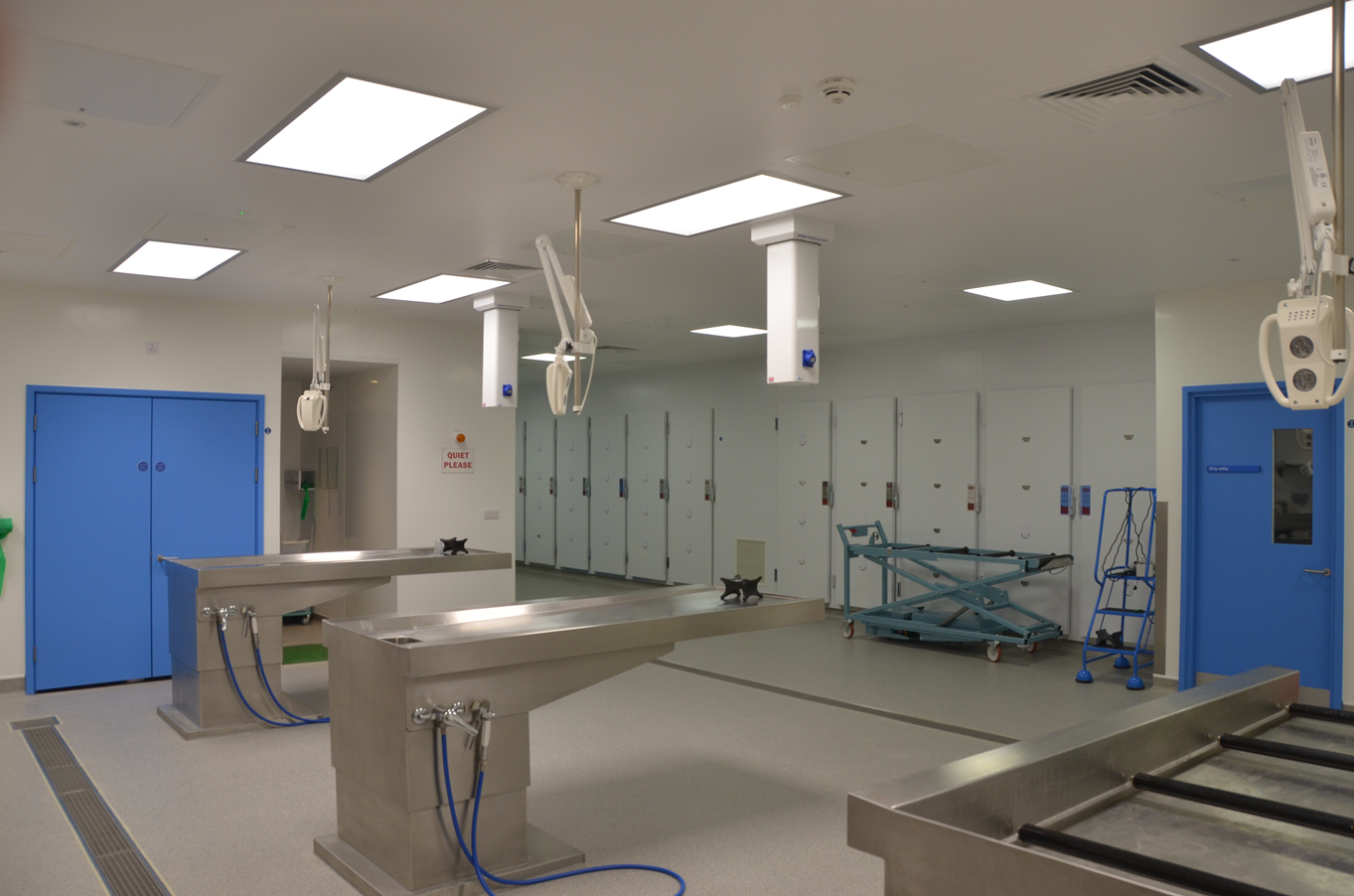
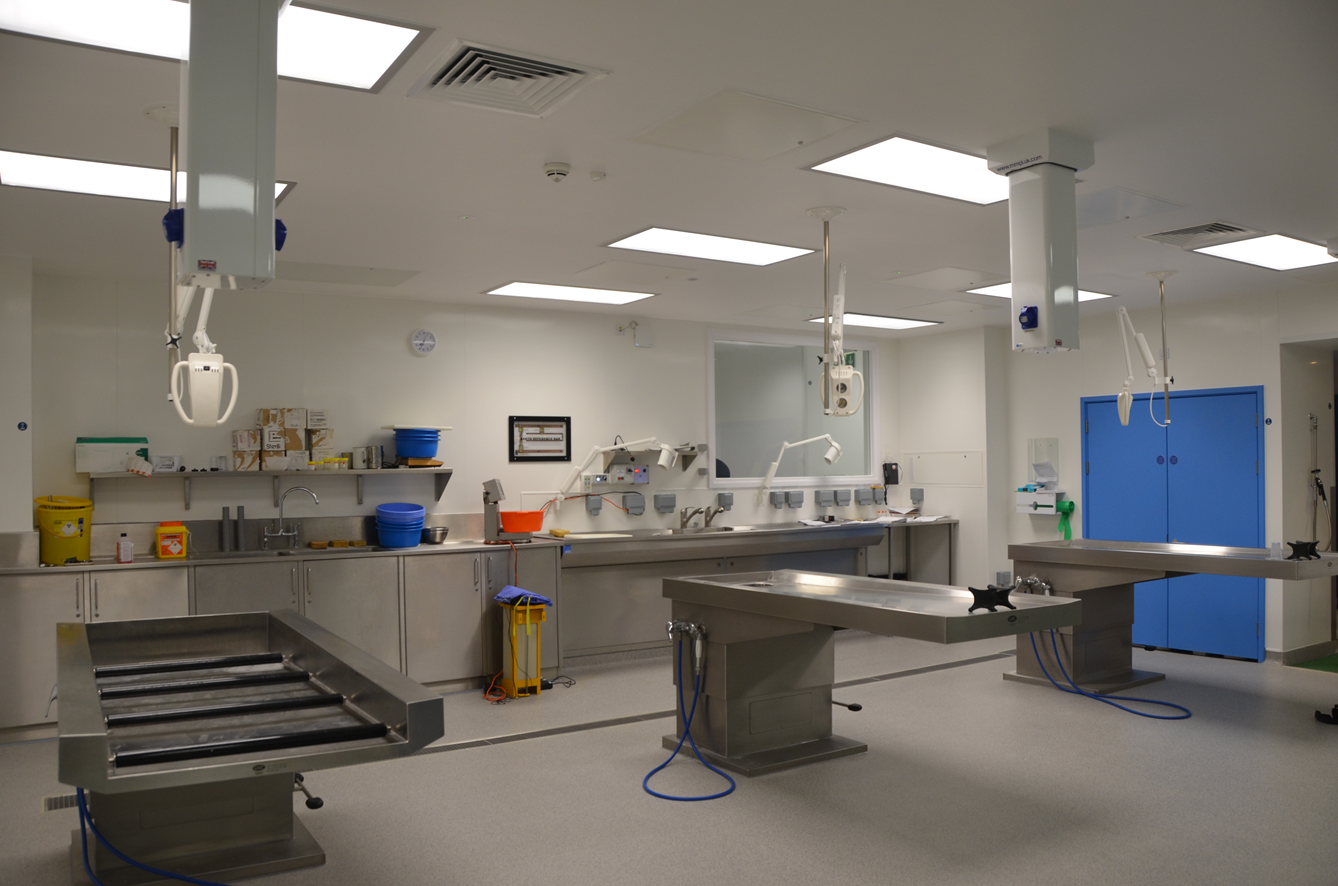
You can see in the photo the fridges behind, that's where the bodies are stored. We've got another bank of fridges outside. In that photo all the name tags have been taken off the fridges. You can see the blue trolley, there’s a shelf on that. You use that to move the body and put it onto the table where the body is examined. In the other photo you can see three tables and then if you look at the far wall there’s a window. That’s where clinicians can watch the autopsy if required.
There are two lights on the arm, that's where I would do the examination of the internal organs. There are extractors which are heavily engineered to pull the air away from us so there's a regular change of air in the room. The hoses are for cleaning and washing down the space and you can see a big drain.
Some hospitals are now doing CT autopsies, avoiding an invasive examination, for example in Manchester and Oxford, where there’s a lot of demand for it. But it's not suitable for all cases, because if you don't know what the cause of death is, you have to go ahead and do the post-mortem.
What happens during a post-mortem examination
What we would do routinely before we start is to look at the clinical history of the case notes for the patient, so the coroner’s post-mortem, the GP summary and the ambulance notes. If they died in a hospital, we've got a combination of the case notes and testimony of the doctor.
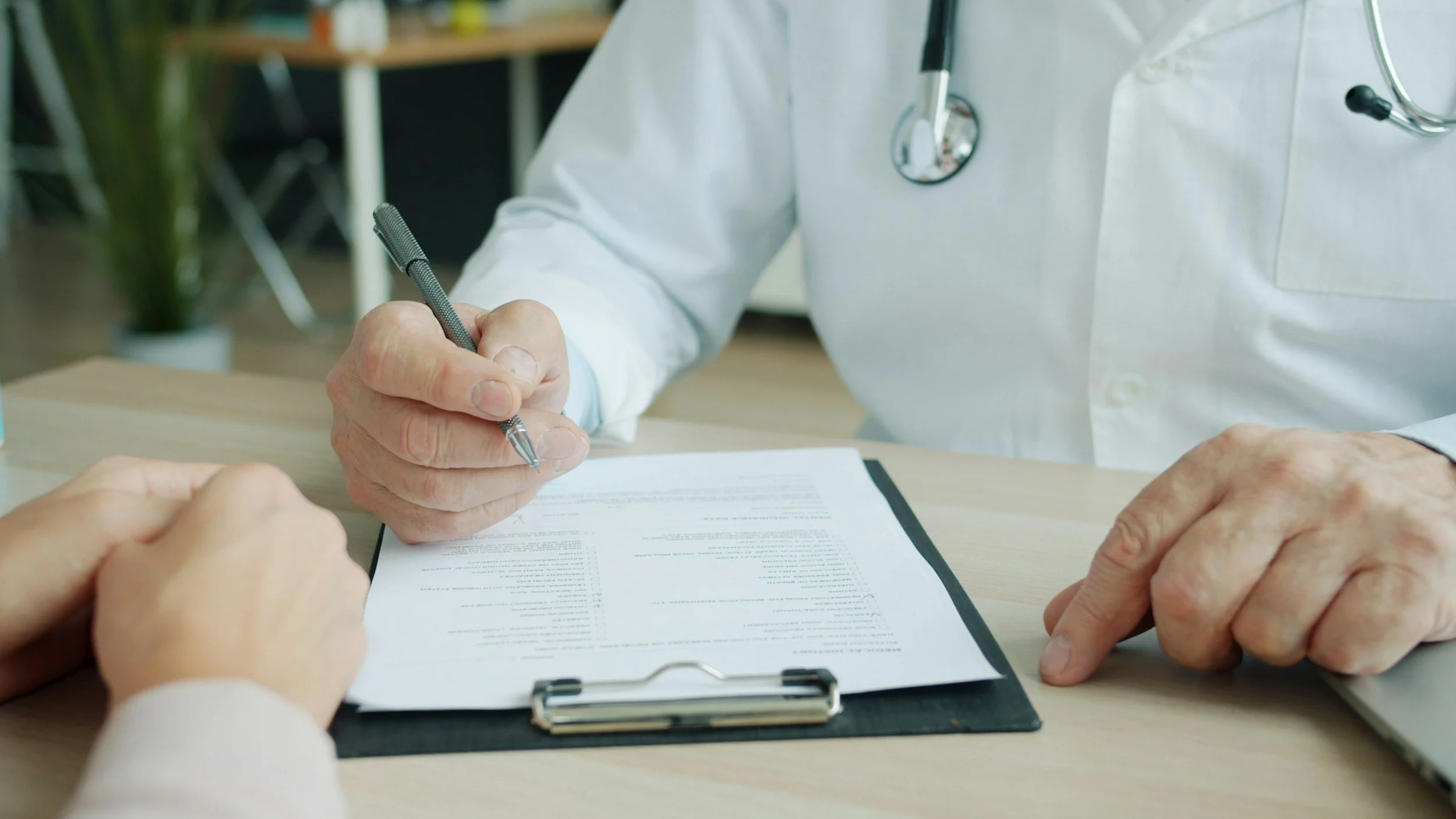
Bodies are first refrigerated, then they’ll have to be identified. We’ll need their history from the GP and to talk to the GP or representative from the surgery. If they can’t issue a cause of the death, then the autopsy will be scheduled. Usually, it's a few days through the medical examiner system. For example, I did cases yesterday who died at the end or middle of last week.
It used to be quicker, but now there's a bit more process, partly because they're trying to encourage doctors and other staff to write up so you may not have to go post-mortem. So, the ones I would get would have failed to get anybody to sign the case up.
There are certain questions to answer, process to follow. I go through the case history of them considering, “What am I likely to find?” “What should I be looking for?”. You do a different post-mortem depending on the circumstances. For example, if somebody was in a diving accident, you'd have a different set up to somebody who died in an old person's home. Then having done that, you would examine the body externally, looking for identifying marks.
“Are the bracelets correct? Is the body who they say they are? Are there any signs of injuries, any identifying marks, etc? Recording any injuries? Did any injuries happen after they died? For example, if somebody collapses and falls down the stairs? Did they have a heart attack at the top of the stairs, or did they fall down the stairs and die at the bottom of the stairs?”
You are trying to work out the sequencing. It begins with an external examination and then we proceed to the internal examination.
I tend to try and find the cause of death first, going through a sequence. Usually, I would examine the heart and lungs first and then the kidneys and bladder and then do the stomach, liver and the spleen from the upper gastro-intestinal, and then re-examine the brain at the end. I would always rather go and look for the cause of death first.
If I don't find it then I've enough time to think, “What if it's another explanation?” So I'm always trying to think “What's the cause of death? What am I finding here? And does everything fit in?”
I look for the coronary arteries. Open the heart up. Look for the heart valves. Make sure there are no defects, and then in the lungs. I would look for standard things. Like, is there a pulmonary embolism there? Any evidence of infection? Pneumonia? Any lung tumours? Same with the liver, stomach, pancreas, spleen. Often there's not a lot. You occasionally might find a urinary tract infection or a heavy blood loss caused by a significant gastro-intestinal haemorrhage.
With the brain: you're looking for signs of a stroke. You are unlikely to see brain tumours in post-mortem practise because most people’s cause of death will be identified and there wouldn't be much confusion about it. But, occasionally, I've seen something that hasn't been picked up before. If appropriate, I might take toxicology to look for drugs or blood alcohol; an example might be a car accident. Similarly, if somebody's taken an overdose or been involved in an accident, you may wish to look for drugs. They may have been taking recreational drugs. So you have a set sequence you would do, but it varies and you have various options.
“The most common cause I would diagnose is ischemic heart disease. The cases I would do at post-mortem will generally be people who die suddenly in the community who haven’t recently seen their GP.”
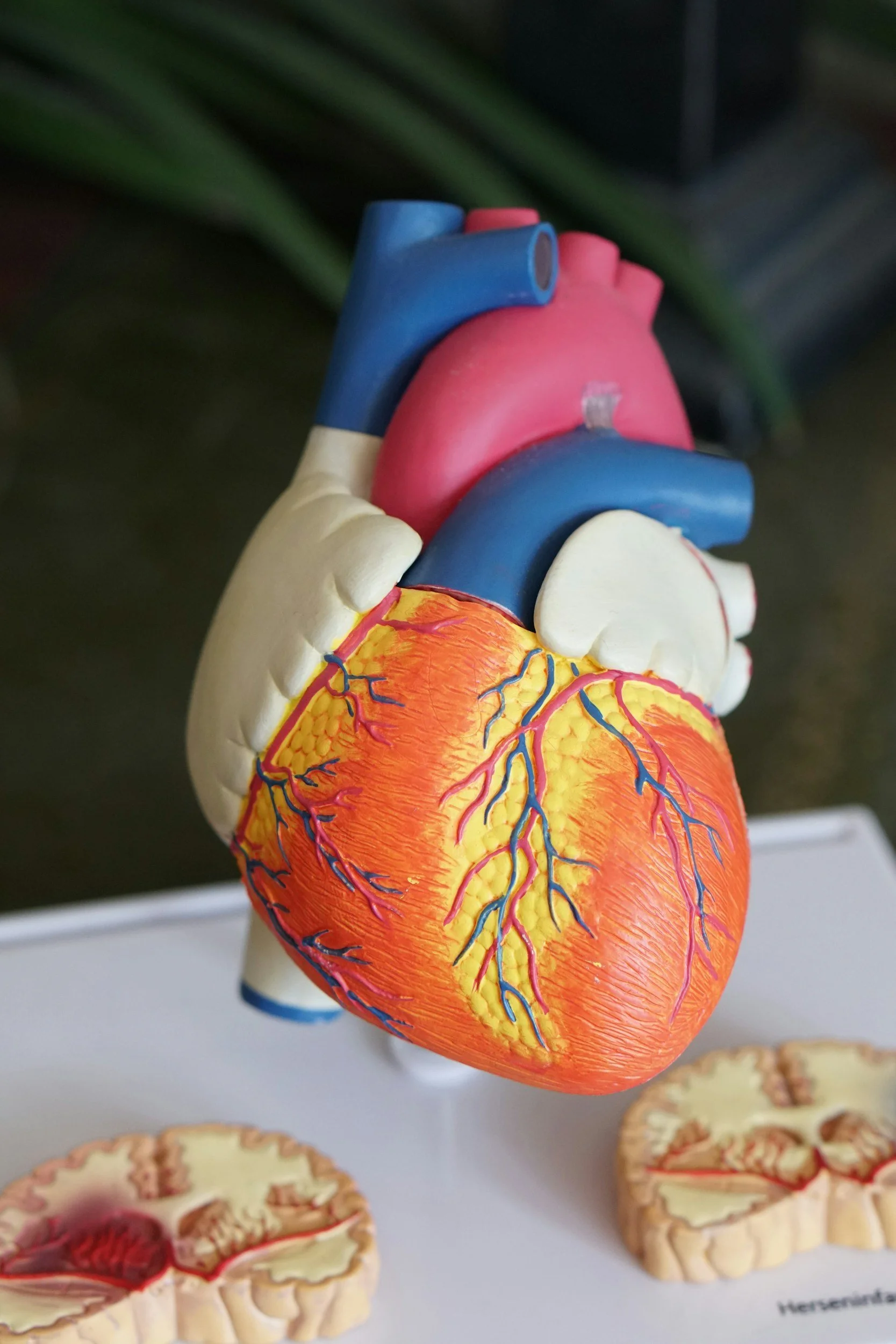
Ischemic heart disease means a lack of blood supply to the heart. What happens with a condition called atheroma is that you get a build-up of fat inside the wall of the artery. The blood flow through that will be much reduced. The oxygen is carried in red blood cells in that blood and the heart just doesn't get enough blood and oxygen. In post-mortem, I would look through those coronary arteries that I'll cut at maybe 3-millimetre intervals to see if there is any blockage.
Autopsies can take 45 minutes to an hour, you can't really get much quicker, but it can be one and a half to two if necessary. I've done so many, I know what I'm doing. Your hand skills, motor skills, you get better and faster, but it's more thinking about it as well. Does this fit with that? Why has this patient got pulmonary oedema? Is there a tumour there? Is there a stroke? Is it cardiac failure? That's why I say enjoy them, because you're really trying to work out a solution.
“When carrying out an autopsy you don’t touch the face or the hands.You make an incision in the back of the skull and pull the scalp forward.”
I've seen forensic cases where there's enough elasticity in the skin so you actually can cut that off and reconstruct it back on, so you can see if there's fractures and bones in there. But that would be very rare, it would certainly be a forensic case. When somebody's in a shroud, you only see their face and hands, you wouldn’t see anything else.
After the autopsy
After autopsy I would email the coroner with the cause of death. Then the paperwork to release the body so then undertakers can come and pick up the body. We reconstruct the body so that it can then be given back to the family.
If the family would like to speak to me about the results, I’ll give them a call and go through the report with them. Unfortunately, they may not always like the outcome because sometimes you can't find a cause of death.
“Between one and 3% of cases you will not find the cause of death, but you just need to say “we've done everything we can, beyond that we can't find anything”. It's difficult, but generally, a post-mortem would help explain why they died.”
It doesn't necessarily make a big difference to the family’s narrative in that moment, but when people are then reflecting on the patient's death by actually knowing why it was, it explains why they had chest pain or other symptoms. It can help with closure in the grieving process. It's a very emotional time when somebody dies and information at that time may seem unhelpful, but often down the track people will reflect. So by having some more information it does help, though maybe not immediately. For unexplained deaths, I just think, the more information the better.
Fluctuations in demand for post-mortems
Sometimes January and Easter can be busy. It can be due to bad weather, but that hasn't been the scenario this year, which is slightly odd. The hospital is completely full, but surprisingly, the mortuary is not as busy as you would think. Usually if the hospital's full, downstairs is full.
It may be there are people not getting to the GPs but then they become ill, come to hospital and then they get better and go home.
So, I'm not quite sure, but there's something slightly odd this year and it's not just this hospital, other hospitals are experiencing the same. The mortuaries are not as busy as we'd expect for the numbers in hospital. We'll take that as a win!
You might have a peak for whatever reason, once or twice a year. That's where sometimes we can be busy in the mortuary and the hospital isn’t particularly busy. If there was a big issue, the Office for National Statistics would release some information.
We built a lot of extra fridge capacity during COVID that we've not had to use, but there is also spare capacity around if we had to. And at that time the council also had spare capacity, with crematoria and cemeteries offering additional limited capacity. Luckily it didn’t come to that. We would normally have about 50 deaths a week, and the council would have capacity for about 150 to 200 a week. The modelling for COVID suggested it was going to be much worse, and then the vaccination came in by Christmas.
Beyond death
I don't do God. But you are conscious many people are religious, and you have to be sensitive about that. I was brought up in religious faith, but I stopped a long time ago. I’ve only known one person who is religious that does post-mortem. My life's too short to worry about these things. Things happen that you can't explain.
“Death will happen, and your approaching sadness about death is about what you're going to miss personally; your family, your friends.”
You don't want it to be painful and don't want to be young. But as you get older, you find more peace with it. My children are adults now, which is quite a different position from if you died young. I think in terms of the physical act of it, there are certain ways you might prefer to go. I'd like to go to bed and just not wake up.
“Most of the autopsies I see are relatively quick deaths and maybe that influences my views on death and dying.”
Misconceptions around post-mortems in the media
I think the biggest misconception about autopsies in TV and film is really the way the pathologist visits the scene of a crime. In reality, most of the information is collected by the police, GP or the ambulance team. But I suspect it's a way of saving money for the production team!
What would usually happen is the police would accumulate the evidence, and we might get a solicitor if it's a big case. Say for a car accident, I would usually have an accident report and photographs on the scene of the crime.
However, I did have one case that was an industrial accident, and I wasn't sure what happened and what the machinery was. So, I contacted the coroner to ask if it would be okay if I went to look because if somebody dies in a motor vehicle accident, you kind of know what that might look like.
“If somebody's in industrial machinery, you think...I'm not quite sure what I should see or not see here. Seeing the machinery was very helpful in terms of explaining what I saw.”
While it didn't make any difference to the cause of death, it meant that if I was in the witness box and there were questions, I would understand what I was being asked.