
Dying for Sex TV Review
Taking back control, healing from trauma and living life to the fullest

Content warning: This review contains major spoilers for Dying for Sex and briefly discusses childhood sexual abuse.
Over the years, death on TV and in the movies has been navigated in a multitude of ways. Award-winning drama Six Feet Under revolved around a family that runs a funeral home, with each episode starting with a death and a series finale which has been described as one of the greatest in television.
Years later, Netflix’s The Good Place comedically explored the concept of the afterlife and what it means to be “good,” while Ricky Gervais’ comedy-drama After Life explored the complexities of grief and how one continues living after the death of a loved one. In 2025, Dying for Sex was a series that also joined the list, but in addition to its exploration of death and end of life care, it went even further, addressing an area that can be considered even more taboo than death itself – sex and intimacy at the end of life.
Studies have shown that many patients nearing the end of their lives have expressed that sex and intimacy are essential to them; however, it is often overlooked by healthcare professionals and not commonly discussed. Dying for Sex steers directly into that very topic, but at the same time, explores themes of empowerment and healing from trauma, as well as what it means to face mortality.
What is the plot of Dying for Sex?
Comedy-drama miniseries Dying for Sex follows Molly (Michelle Williams), who, after being diagnosed with stage four metastatic breast cancer, decides to leave her husband and explore her sexuality for the first time in her life. Alongside Michelle Williams, the cast includes Jenny Slate as Nikki, Molly’s scatterbrained best friend; Rob Delaney as Neighbour Guy, Molly’s main love interest, and Sissey Spacek as Gail, Molly’s estranged mother.
Even with its limited run, Dying for Sex received a largely positive response from critics, along with a string of Emmy Awards, including Outstanding Limited or Anthology Series, and acting nominations for Michelle Williams, Jenny Slate, and Rob Delaney (with Williams later winning the 2026 Golden Globe for Best Actress in a Limited Series).
Is Dying for Sex based on a real story?
The series is loosely based on the real-life story of Molly Kochan, who co-created the podcast Dying for Sex alongside her best friend Nikki Boyer. The podcast documents how, after her terminal cancer diagnosis, Molly left her husband and subsequently began her journey of sexual exploration. Kochan died in 2019, with her memoir, Screw Cancer: Becoming Whole, which she wrote during the final months of her life, being published in 2020.
Several elements of the TV show have been adapted in terms of characters and timelines but the portrayal of Molly and Nikki’s friendship remained faithful to their real-life one, with Boyer herself commenting that it felt like “the core of us” and how “they took funny, specific things and kept them.”
What happens to Molly in Dying for Sex?
At the heart of Dying for Sex is Molly wanting to take back control in the face of the uncontrollable. Her desire to explore her sexuality not only comes from being seen and treated like a ‘sick person’ for so long, but also due to the experience of sexual abuse at the hands of her mother’s boyfriend when she was a child. In the first episode, we see her try to initiate sex with her husband, but the encounter ends abruptly with him crying in her lap after, as Molly puts it, “my boobs make you think about death.”
It’s after a meeting with Sonya, her palliative care nurse, that Molly adds her first and only wish to her bucket list: an orgasm with another person. Over the course of the series, she leaves her husband, gets on the dating apps, experiments with sex toys, attends a sex party, and that’s just for starters. In learning to find her voice and express what she wants in the bedroom, Molly also learns to bring this into her medical care, speaking up to her oncologist, Dr Pankowitz, about what she needs from him during her treatments. This comes after her health concerns were dismissed by her old doctor years earlier, who refused to order a mammogram, telling her she was “too young” to have breast cancer.
Through her string of sexual encounters including recurring ones with her neighbour, aptly named ‘Neighbour Guy’, Molly keeps her diagnosis under wraps, opting to cover up her mastectomy scars and hiding her medications. However, this plan is later foiled thanks to her mother, Gail, letting the cat out of the bag, forcing Molly to come clean. Fearing that their relationship will turn into a “tragic love story”, Molly offers Neighbour Guy the chance to call the whole thing off, but he tells her, “Just keep kicking me in the d**k” (if you know, you know). He doesn’t see her as a sick person, even during their final encounter together in Molly’s hospital room, where she finally gets to tick that all important orgasm off her bucket list.
"Your body knows how to die”
Despite only appearing in the final episode, one of the standout characters is Molly’s hospice nurse, Amy (played by Paula Pell). Arguably, one of the most iconic scenes of the series is when she talks Molly, Nikki and Gail through the process of dying in a raw, honest, and surprisingly uplifting manner, even to the point where she talks about her “favourite part of the dying process.”
“Death is not a mystery. It is not a medical disaster. It is a bodily process, like giving birth, or going to the bathroom, or coughing, or having an orgasm. Your body knows what to do. Your body knows how to die. How cool is that?” - Nurse Amy
Amy’s enthusiasm towards the dying process is understandably not something that everyone will be comfortable with (as Nikki proves in this very scene). However, in a world where death on TV is often depicted in a sombre tone with sad music and plenty of tears, it’s a refreshing perspective to see it being discussed in such an uplifting, natural way. It also addresses the less talked about elements of the dying process, such as ‘terminal secretions,’ (a phrase which Molly snickers at) and Molly asking Nikki to make sure her mouth is closed after she dies, with Nikki pleading with her not to bite her.
Laughing in the face of death
Despite its subject matter, Dying for Sex certainly doesn’t shy away from the comedic elements. Molly approaches her diagnosis with humour throughout the series, with multiple laugh-out-loud moments. One of the funniest moments of the series comes after a bathroom-related escapade goes from bad to worse (again, if you know, you know), but there's plenty of smaller moments peppered in, even in the final few episodes, such as Molly and Nikki making fun of a young doctor for having a Harry Potter-themed scrub-cap, and when Nikki politely refuses to give up her puzzle to a young boy in the hospice waiting room:
How does Dying for Sex end?
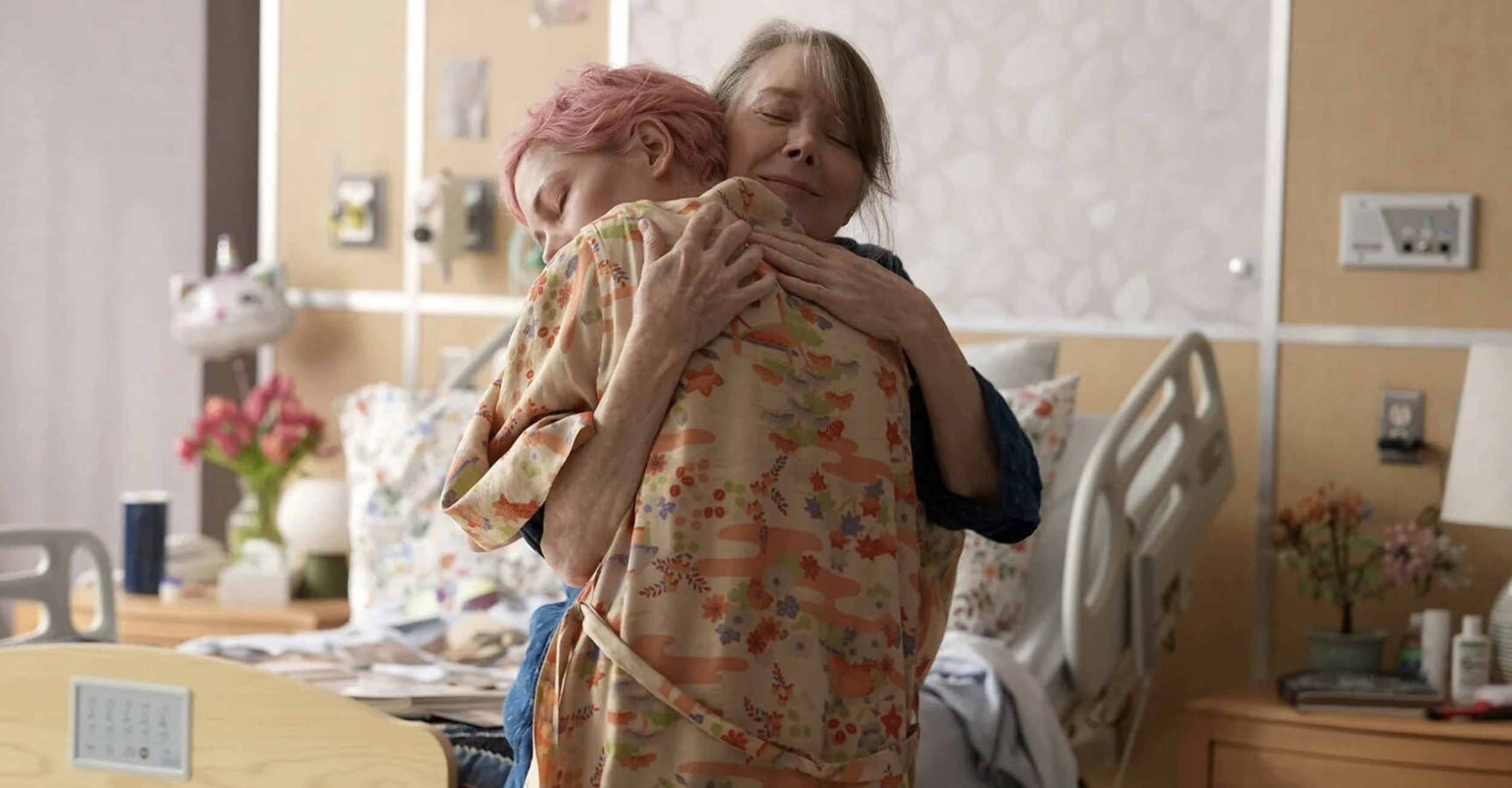
It's clear from the first moments of the very first episode how Dying for Sex will end, but that doesn’t take away the impact of those final scenes. As predicted by Nurse Amy earlier in the episode, Molly is shown to be experiencing “the rally,” a temporary, unexpected surge in energy and mental clarity that occurs shortly before death, and despite knowing where it’s leading, it’s still one of the most joyful moments of the show. At this point, Molly has made her peace with her relationships – with her best friend, with her mother, and most crucially, herself. Her experience of the rally is a simple but beautiful one – a dance party in her room at the hospice with Gail and Nikki, while decorating the walls with photos.
The contrast comes in the form of the next scene, where Molly confesses that she’s ready to die. Having previously refused sedation because she wanted to “feel everything I can for as long as I can”, she confesses, “I thought it would feel good, but it just hurts.” Despite this, Molly’s sense of humour is still present even in her final moments of consciousness, telling Nikki and Gail: “You know what? It’s not that f**king serious. Let’s get this show on the road.”
What’s even more poignant is how she follows it up: “You know how many trips and plans I had to cancel because I was sick? Now I get to take one that’s mine alone.” She’s not afraid, but she’s excited.
Molly’s final scene is beautifully simple. We see time pass as Molly sleeps, with Nikki by her side the entire time. As Molly takes her final breath, Nikki holds her hand and tells her, “I’ve got you.” What follows is a bittersweet moment of humour, where, in a callback to earlier in the episode, she attempts to close Molly’s mouth, but it pops back open. Wanting to fulfil her friend’s final request, she opts to secure it by placing her hoodie under Molly’s chin, before telling her, “Thank you for not biting me.”
The closing scene, while brief, still paints a painfully accurate picture of grief and those bittersweet moments that remind us of a loved one who’s no longer here. Nikki is seen leaving work and meeting up with her boyfriend, only to catch sight of two old ladies laughing and chatting about (clearly indicated by their hand gestures!) sex. The final shot is of Nikki giving a sad smile at what she and Molly could have been together in another life, summing up just how those little moments of joy that remind us of a loved one can also come with a deep pang of grief.
Should you watch Dying for Sex?
So, is Dying for Sex likely to be for everyone? Absolutely not. While the show had a largely positive response from critics, with many praising the relationship between Molly and Nikki, as well as the portrayal of female sexuality in the context of living with cancer, it wasn’t completely immune to criticism. Some were less impressed with the combination of sex and death, even referring to the sex scenes as ‘distracting’ from the core story. Some also claimed that elements of the show were unrealistic and shied away from some of harshest realities of living with cancer and going through chemotherapy.
At its core, Dying for Sex is a moving portrayal of empowerment, friendship, and forgiveness. Most importantly, it portrays one of (if not the) most crucial elements of palliative care: supporting the person to live as well as they can for as long as they can. As Sonya tells Molly in the first episode “palliative care is all about how you want to live with this.” It’s about prioritising what matters most and giving the person back their power, and, ultimately, that’s what makes it a must-watch.
Dying for Sex is streaming on Disney Plus in the UK, and Hulu in the US.
Image credits:
https://www.imdb.com/title/tt30252752/mediaviewer/rm3275918594/?ref_=ttmi_mi_2_1
